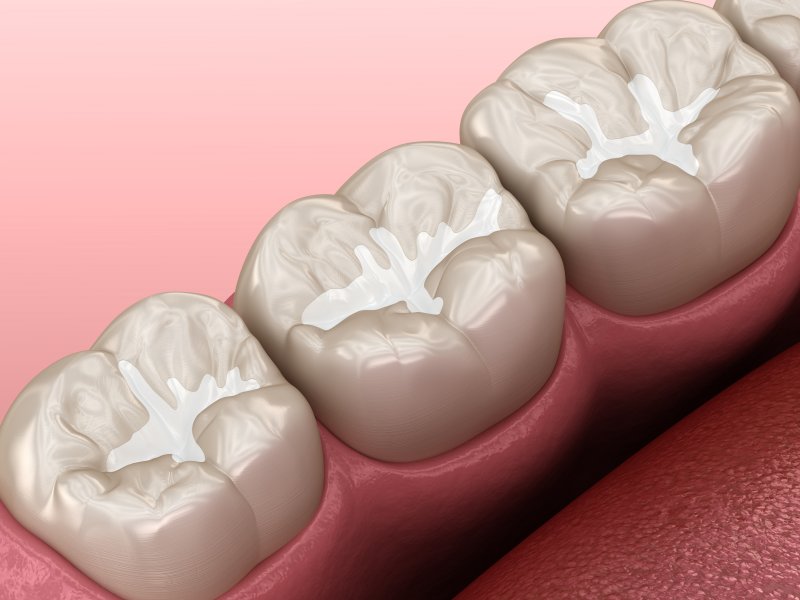
As much as you may wish otherwise, dental fillings don’t (and can’t) work forever. These materials eventually wear out and need replacing after a while. Given these facts, perhaps you’re wondering: Just how long do dental fillings last? You don’t need to turn over this question aimlessly; your Temple dentist will gladly address it for you. To that end, please keep reading to learn about dental fillings and their lifespan(s), replacement indicators, and maintenance methods.
The Lifespan(s) of Dental Fillings
Though their exact lifespans vary by patient, average dental fillings last for about ten years. Whether or not your own works that long will depend on several factors.
To give an example, consider your filling’s material. If it’s made of amalgam, it’s likely sturdy enough to last (with good care) for fifteen years. In contrast, a glass iomer filling is much more fragile; it should only work for five years at most.
Personal lifestyle also plays a role here. After all, whether a filling lasts a long or short time is partly based on your eating habits, oral hygiene, and so on. How well you maintain your smile (if at all) will greatly impact your treatment’s final lifespan.
Signs You Should Replace Your Filling
Only a dentist will know if your filling “needs” a replacement. Still, various signs can indicate that your treatment results are near their end.
Say that your filled tooth feels sore, for instance. This sensitivity implies that your filling isn’t working well, as it’d normally prevent any aches. You’d probably want to see your dentist for a re-treatment once your tooth has twinges of pain.
A cracked or worn-down filling is another notable sign. When a filling’s material has visible damage, it’s unlikely to protect the treated tooth for much longer. Failing to get a replacement quickly could thus lead to a cavity or infection.
How to Take Care of Your Fillings
Despite the above, you can do things to help your fillings last as long as possible. The most notable of these tips and tricks include:
- Quit Bad Oral Habits – Since nail-biting and teeth-grinding harm fillings, quitting them would reduce the wear and tear on your treatment results.
- Practice Good Oral Hygiene – If you brush twice daily and floss once daily, you’ll keep a lot of plaque from reaching your teeth and eroding your fillings.
- Get Frequent Checkups – Through regular dental visits, a dentist can treat issues that might threaten your dental fillings.
All things considered, how long your dental fillings last is up to you. Remember that as you maintain your smile from now on.
About the Author
Dr. Richard Fossum is a dentist based in Temple, TX, having earned his DDS from the UTHealth Houston School of Dentistry. Thirty-plus years in the field have made him an expert in preventive, cosmetic, and even restorative dentistry, as well as dental emergencies. You can thus trust him (and his team) to provide the help your grin truly needs! Today, Dr. Fossum practices at his self-titled clinic and is reachable on his website and by phone at (254)-831-4397.